What Is the Best Height for a TV Unit?
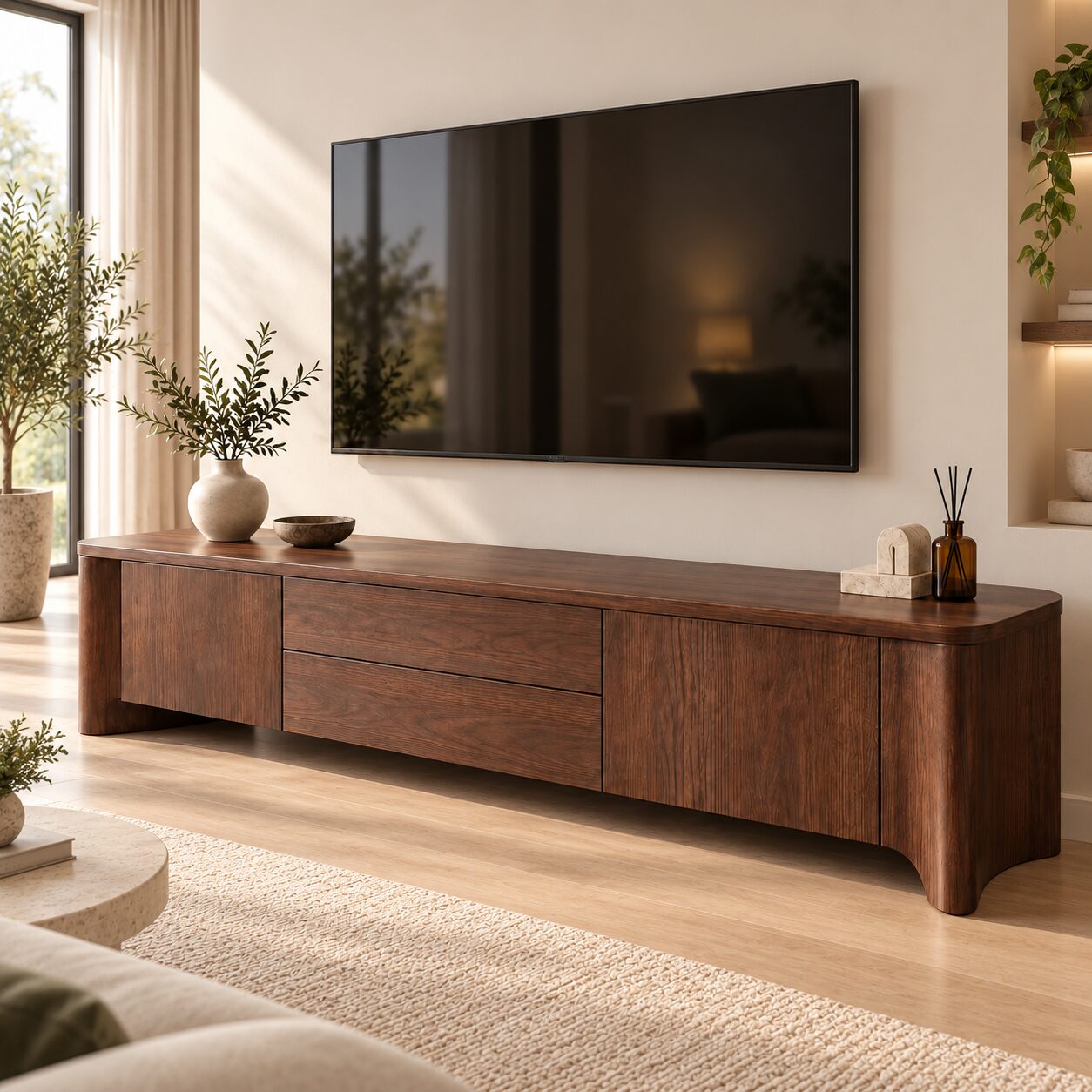
The best height for a TV unit is the one that puts the Centre of your screen at, or just below, your seated eye level. For most Australian living rooms, that means a unit roughly 40 to 65 cm tall, depending on your TV size and sofa. If you’re buying new furniture, upgrading your TV or setting up a living room from scratch, this guide shows you how to measure and calculate the right number. It covers eye level, TV size, wall-mounting, room type, common mistakes and how to balance the whole setup.
Key Highlights
- Rule of thumb: aim for the screen Centre at seated eye level, about 100 to 110 cm from the floor.
- Simple formula: unit height = eye level − half the TV’s height − the TV’s foot clearance.
- Bigger TV, lower unit: a 75-inch TV usually suits a lower unit than a 43-inch TV.
- Slightly low beats too high: a screen a little below eye level is more comfortable than one above it.
- Wall-mounted TV: the mounting height matters more than the unit under it.
- Always check: your sofa height, viewing distance and your TV’s actual spec sheet.
Why the Best Height for a TV Unit Starts With Eye Level
Your TV unit doesn’t set the viewing height by itself. The height of the unit plus the height of the TV decides where the screen ends up, and that screen position is what affects comfort.
What Is a Typical Seated Eye Level?
On a standard sofa, seated eye level is commonly around 100 to 110 cm from the floor. It’s a little lower on deep, relaxed lounges and recliners, and a little higher on upright dining-style chairs. These are typical figures, not fixed rules, so measure your own seating.
What Happens If the Screen Is Too High or Too Low?
A screen that sits too high makes you tilt your head upward, which gets tiring over a long movie. A screen that sits too low makes you look down for long periods. Of the two, slightly low is usually easier to live with than too high, so don’t worry about being a few centimeters under eye level.
How to Calculate the Right TV Unit Height
This is the most useful part of the guide. You only need a tape measure.
- Sit in your normal viewing position on the sofa you actually use.
- Measure from the floor to your eyes. This is your seated eye level.
- Measure your TV’s height from top to bottom, including the frame (check the spec sheet if it’s already mounted or boxed).
- Measure the foot clearance. This is the gap between the bottom of the TV and the surface it sits on, often around 3 to 8 cm.
- Work it out: unit height = eye level − (TV height ÷ 2) − foot clearance.
Worked example. Say your seated eye level is 105 cm and you own a 55-inch TV that is about 69 cm tall with 5 cm feet.
- Half the TV height = 34.5 cm
- 105 − 34.5 − 5 = 65.5 cm
That puts the screen centre exactly at eye level. If you’d rather sit slightly above the screen centre, a 55 to 60 cm unit gives you a comfortable range. A 45 cm lowline unit would place the centre about 20 cm below your eyes, which works for deep, relaxed seating but may feel low on an upright sofa.
Best Height for a TV Unit by TV Size
Screen dimensions follow the standard 16:9 aspect ratio, so you can estimate your TV’s height from its diagonal. The table below assumes a 105 cm seated eye level and 5 cm feet. Always confirm the real dimensions on your TV’s spec sheet.
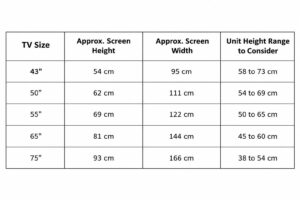
The lower end of each range puts the screen centre about 15 cm below eye level, which is still comfortable for most people. The takeaway is that a bigger screen is taller, so it generally needs a lower unit. TV size helps set proportions, but it doesn’t dictate one universal height. Your eye level and sofa matter just as much.
What Is the Best Height for a TV Unit for a 55-Inch TV?
For a 55-inch TV, a unit around 50 to 65 cm tall suits most sofas. Use the formula above with your own eye level to land on an exact figure.
TV on a Unit vs Wall-Mounted TV
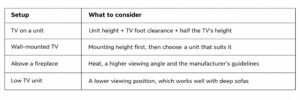
With a wall-mounted TV, the same rule applies: aim for the screen centre at roughly seated eye level. Then choose a unit that leaves a visual gap of about 15 to 25 cm beneath the screen, so the two don’t look cramped.
What Is the Standard Height of a TV Unit?
There isn’t a strict standard, but typical ranges look like this:
- Lowline units: about 35 to 50 cm
- Mid-height units: about 50 to 70 cm
- Tall or wall units with shelving: 70 cm and above
Heights vary because of design, storage needs, TV size, room proportions and whether the TV is mounted. Treat these as common ranges, not rules.
How Sofa, Room and Layout Change the Best Height
- Sofa height: a higher sofa lifts your eye level, so a slightly taller unit may suit it.
- Seating posture: upright seating raises your eyes, and reclined seating lowers them.
- Viewing distance: as a rough guide, many people sit around 1.5 to 2.5 times the screen’s diagonal away. A 55-inch TV (about 140 cm diagonal) suits roughly 2 to 3.5 m.
- Room size: in a small room, a tall unit can feel heavy. In a large room, a very low unit can look undersized.
- Furniture layout: the unit should balance the sofa, coffee table and nearby storage rather than dominate them.
TV Unit Height by Room Type
- Living room: use the eye-level calculation for everyday comfort.
- Bedroom: you’re often viewing from a bed, so eye level is lower. Choose a lower unit or a wall mount positioned for lying or sitting up in bed.
- Apartment or small living room: a lowline or wall-mounted option keeps the space open. It still needs to fit the TV and equipment safely.
- Open-plan area: a mid-height unit with storage can help define the entertainment zone.
Are Low TV Units Better?
Not automatically. Low units suit large TVs and modern interiors, create a lighter look and keep the room less cluttered. The trade-offs are less vertical storage, and they may not suit upright or high sofas. Whatever the style, the screen’s viewing height still has to work.
Choosing TV Unit Width, Depth and Storage
Height is only one part of the decision.
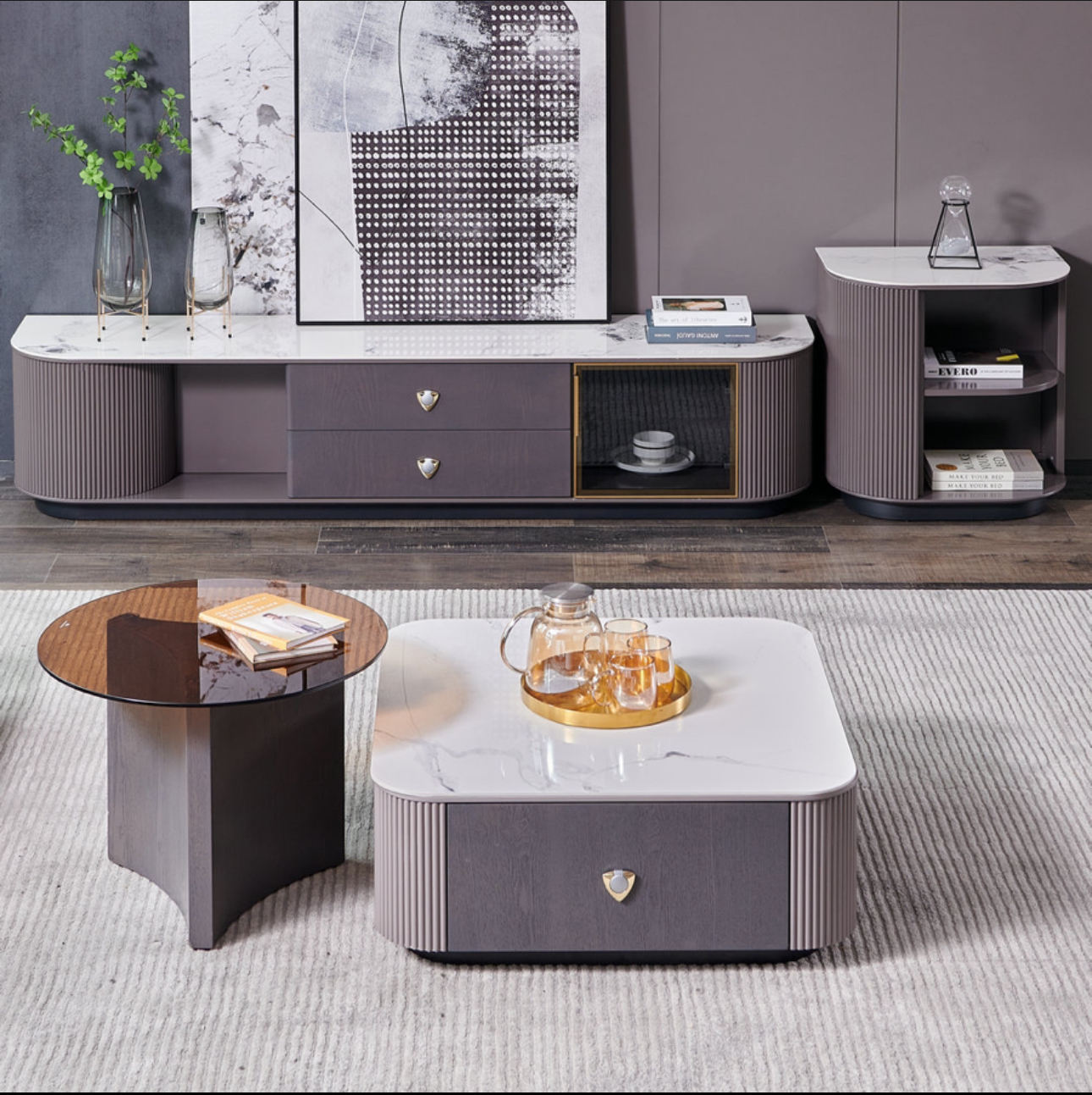
- Width: choose a unit wider than the TV so it looks balanced. A 55-inch TV (about 122 cm wide) pairs well with a unit around 150 cm or wider.
- Depth: allow enough space for devices and cables without pushing the unit far into the room.
- Storage: think about drawers, shelves, consoles, soundbars and cable management.
- Safety: fix tall units and TVs to the wall with anti-tip fittings. Product Safety Australia has guidance on furniture and TV tip-over risks.
Common TV Unit Height Mistakes to Avoid
- Choosing a unit that is too tall, which pushes the screen above eye level
- Placing the TV too high, especially above a fireplace
- Ignoring sofa height, which changes your eye level
- Choosing a unit too narrow for the TV
- Forgetting cable management
- Ignoring storage needs
- Choosing on looks alone, without measuring
How to Make a TV Unit Look Balanced
- Match the unit’s width to the TV, with it slightly wider
- Leave breathing space around the screen
- Coordinate colors and materials with your sofa and coffee table
- Avoid overcrowding the top surface
- Hide cables where possible
- Style with a few pieces rather than many
Conclusion
The best height for a TV unit is the height that gives you a comfortable viewing position while keeping the TV, sofa and room in proportion. Don’t rely on a standard measurement alone. Consider your seated eye level, TV dimensions, viewing distance, furniture proportions and storage needs. Ready to choose? Browse our TV units and entertainment units.
Frequently Asked Questions
What is the best height for a TV unit?
The best height for a TV unit puts the screen Centre at or slightly below your seated eye level. For most homes that means a unit of about 40 to 65 cm.
What is the standard height of a TV unit?
There is no strict standard. Lowline units are typically around 35 to 50 cm and mid-height units around 50 to 70 cm.
How high should a TV be above a TV unit?
If the TV is wall-mounted, leave roughly 15 to 25 cm above the unit. If it sits on the unit, the feet set the gap.
Should a TV unit be lower than the sofa?
Not necessarily. What matters is where the screen Centre lands relative to your seated eye level.
Is a low TV unit better for a large TV?
Often yes, because large TVs are taller. A lower unit keeps the screen Centre closer to eye level.
How high should a 55-inch TV be?
Aim for the screen Centre at about 100 to 110 cm from the floor, depending on your seated eye level.
How do I measure the right TV unit height?
Measure your seated eye level, subtract half the TV’s height and the foot clearance, and use the result as your target.
What is the best TV unit height for a small living room?
A lowline unit or a wall-mounted TV with a compact unit below. Make sure it still holds your TV and equipment safely.



Leave A Comment
You must be logged in to post a comment.